SDR-RTL.COM MODEL V4 USB DONGLE
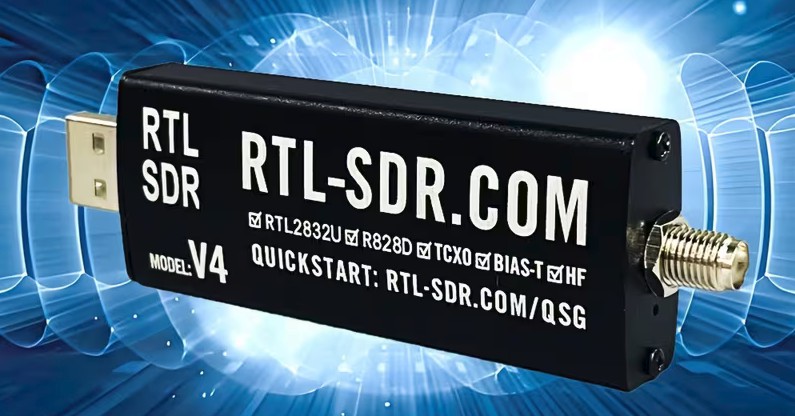
RTL-SDR V4 USB Software Defined Radio Receiver with High-Gain Antenna, Compact Design for Office, Lab & Commercial Use - No Assembly Required, Durable Black, Sleek Metallic Finish, Antenna for, Office Communication, Modern Tech Look, Sturdy Construction
SOFTWARE FOR THIS RECEIVER
https://www.bev.ba/REFERENCE/radioamater/SDRWINDOWS64/
https://www.bev.ba/REFERENCE/radioamater/SDRSHARP/
HDSDR is a freeware Software Defined Radio (SDR) program for Microsoft Windows 2000/XP/Vista/7/8/10/11.
https://bev.ba/REFERENCE/radioamater/HDSDRWINDOWS/
What is the RTL-SDR V4?
The RTL-SDR Blog V4 is a compact USB software-defined radio receiver that transforms any computer into a professional RF scanner. Featuring the RTL2832U ADC chip and R828D tuner, it captures signals from 500 kHz to 1.7 GHz—an incredibly wide range covering HF, VHF, UHF, and microwave bands. The V4 is purpose-built for ADS-B aircraft tracking, weather satellites, amateur radio monitoring, and spectrum analysis, making it the go-to budget receiver for SDR enthusiasts worldwide.
What's in the Complete V4 Kit
- RTL-SDR Blog V4 Dongle: R828D tuner, RTL2832U ADC, 1PPM TCXO, aluminum case, passive cooling, SMA F connector
- Portable Multipurpose Dipole
Antenna Set:
- Dipole base with 60cm RG174 cable
- 2× 23cm–1m telescopic antennas (for lower frequencies and general use)
- 2× 5cm–13cm telescopic antennas (optimized for ADS-B and higher frequencies)
- 3m RG173 Extension Cable: For remote antenna placement
- Flex Tripod Mount: Portable, flexible antenna positioning
- Suction Cup Mount: Window mounting for outdoor antenna setup
Hardware Specifications
| Specification | RTL-SDR V4 | Notes |
|---|---|---|
| Frequency Range | 500 kHz – 1.7 GHz | HF (500 kHz) to UHF/microwave coverage with built-in upconverter |
| HF Reception | 500 kHz – 28.8 MHz (with internal upconverter) | Built-in 28.8 MHz low-pass filter for optimal HF performance |
| VHF/UHF | 88 MHz – 1.7 GHz direct reception | No upconversion required; native tuning |
| Real-Time Bandwidth | 2.4 MHz stable (3.2 MHz peak) | Instantaneous bandwidth for simultaneous signal capture |
| Tuner Chip | R828D (improved over previous models) | Better sensitivity and lower noise than standard R820T2 |
| ADC | RTL2832U (8-bit) | Professional direct-conversion receiver architecture |
| Oscillator | 1PPM TCXO (Temperature-Compensated Crystal Oscillator) | Superior frequency accuracy and stability |
| Connector | SMA F (female) | Standard RF connector; all antennas included |
| Bias Tee | Software-activatable | Powers external LNAs and active antennas directly from dongle |
| Case | Aluminum with passive cooling | Improved thermal management prevents frequency drift |
| USB Interface | USB 2.0 Type-A | Data transfer via bulk USB endpoints |
| Power Consumption | ~500 mA @ 5V (2.5W) | USB-powered; no external power required |
| Operating System Support | Windows, macOS, Linux, Raspberry Pi, Android | Excellent cross-platform compatibility |
| Front-End Filtering | Improved filtering in V4 | Reduces out-of-band interference and intermodulation |
| ESD Protection | Extra protection circuitry | Better protection against electrostatic discharge |
Key Improvements in V4 Over Previous Models
- R828D Tuner: Better sensitivity and lower noise floor compared to standard R820T2 tuners used in clones.
- HF Reception (500 kHz): Built-in upconverter with 28.8 MHz low-pass filter enables shortwave reception—unique to RTL-SDR Blog quality dongles.
- 1PPM TCXO: Temperature-compensated oscillator dramatically improves frequency stability compared to standard 25 MHz crystals.
- Improved Front-End Filtering: Optimized RF filtering reduces spurious signals and intermodulation products.
- Better PCB Design: Lower-noise PCB layout with improved component placement reduces internal interference.
- Enhanced ESD Protection: Extra protection diodes and filtering prevent static discharge damage.
- Software-Activatable Bias Tee: Powers external LNAs and active antennas directly from the dongle without external supplies.
- Aluminum Cooling Case: Passive thermal management prevents frequency drift during extended operation.
Performance Benchmarks
- FM Broadcast Reception (88-108 MHz): Excellent sensitivity; receives weak local stations from 50+ miles with included dipole antenna.
- ADS-B Aircraft Tracking (1090 MHz): Typical range 100-150 miles with included short antenna; 250+ miles achievable with external antenna and bias-tee powered LNA.
- NOAA Weather Satellites (137-138 MHz): Receives clear APT imagery with V-dipole configuration; performance rivals dedicated marine antennas.
- Amateur Radio (144-148 MHz, 430-450 MHz): Full VHF/UHF coverage with excellent reception quality in SDRangel or GQRX.
- Shortwave/HF (500 kHz-28.8 MHz): International broadcasts, amateur radio, and maritime communications via built-in upconverter.
- Maritime AIS (161-162 MHz): Decode ship positions and vessel data in real-time.
- GSM/4G Spectrum Monitoring (850/900/1800/1900 MHz): Monitors cellular bands; cannot decode encrypted signals but provides spectral analysis.
Compatible Software (All Free/Open-Source)
- GQRX: General-purpose SDR receiver with waterfall display—best for beginners and all-purpose use
- SDR#: Windows-focused with excellent plugin ecosystem; most versatile software
- SDRangel: Advanced multi-demodulator with plugin architecture—best for complex analysis and professional work
- CubicSDR: Cross-platform receiver with excellent user interface and stability
- dump1090: ADS-B aircraft tracker—dedicated and highly optimized for aircraft monitoring
- WXTOIMG: Automated NOAA weather satellite image capture and processing
- GNU Radio: Build custom receiver flowgraphs for specialized applications and research
- QSSTV: Slow-scan television and weather satellite imagery reception
Real-World Use Cases
- ADS-B Flight Tracking: Monitor aircraft in real-time on interactive maps—incredibly popular and addictive hobby that feeds services like Flightradar24.
- Weather Satellite Reception: Capture NOAA satellite imagery directly—free weather data from space with professional-quality imagery.
- FM Radio Reception: Listen to local radio stations with computer; build a software-defined radio station receiver with better quality than traditional receivers.
- Amateur Radio Monitoring: Tune into ham radio nets, repeaters, and emergency communications—great for hobbyists and emergency preparedness.
- Spectrum Analysis: Monitor RF activity across wide frequency range; identify interference, rogue transmitters, and signal anomalies.
- Cellular Network Monitoring: Analyze 4G/5G spectrum activity (receive-only); understand network topology and coverage patterns.
- Maritime AIS Tracking: Monitor ship positions, vessel information, and maritime traffic in your region.
- Shortwave/International Radio: Listen to international broadcasts, time signals, and maritime communications via HF reception.
Strengths
- Outstanding Value: Professional-grade receiver at an entry-level investment—performance rivals devices costing 5-10× more.
- Widest Frequency Coverage: 500 kHz to 1.7 GHz covers more spectrum than competing budget receivers.
- Complete Kit Included: Multipurpose antenna kit, extension cables, and mounting options—everything needed to get started immediately.
- HF Reception Built-In: Unique 500 kHz starting frequency with optimized filtering—most budget dongles start at 24 MHz.
- Superior Tuner: R828D tuner outperforms clones and standard R820T2 alternatives.
- Frequency Stability: 1PPM TCXO ensures stable reception for critical applications requiring precise frequency accuracy.
- Zero Learning Curve: Plug-and-play with intuitive software; no configuration required for basic use.
- Massive Community: 15+ years of RTL-SDR development; countless tutorials, projects, and support forums.
- Cross-Platform: Excellent Linux support plus Windows, macOS, Raspberry Pi, and Android compatibility.
- No Licensing: Receive-only operation—no FCC licensing required in most jurisdictions.
- Endless Customization: Build custom antennas, create GNU Radio flowgraphs, develop software plugins.
- Bias Tee for LNA Power: Powers external low-noise amplifiers directly—no separate power supply needed.
Limitations
- 8-Bit ADC: Lower resolution than professional equipment; dynamic range limited to ~50 dB.
- USB 2.0 Bottleneck: Max 2.4 MHz sustained real-time bandwidth due to USB 2.0 throughput limits.
- No Transmit: Receive-only; cannot generate RF signals (unlike HackRF or USRP).
- Proprietary Drivers Required: RTL-SDR Blog drivers differ from standard RTL-SDR drivers; requires careful installation.
- Encryption Decoding: Cannot decode encrypted digital signals (P25, DMR, Tetra, etc.).
- Limited Filtering in Stock Form: Out-of-band interference possible in high-RF environments without external bandpass filters.
Owner Rudolf Bošnjak - E71RB, Sarajevo, Bosnia and Herzegovina...
Click above photo to see a larger photo.